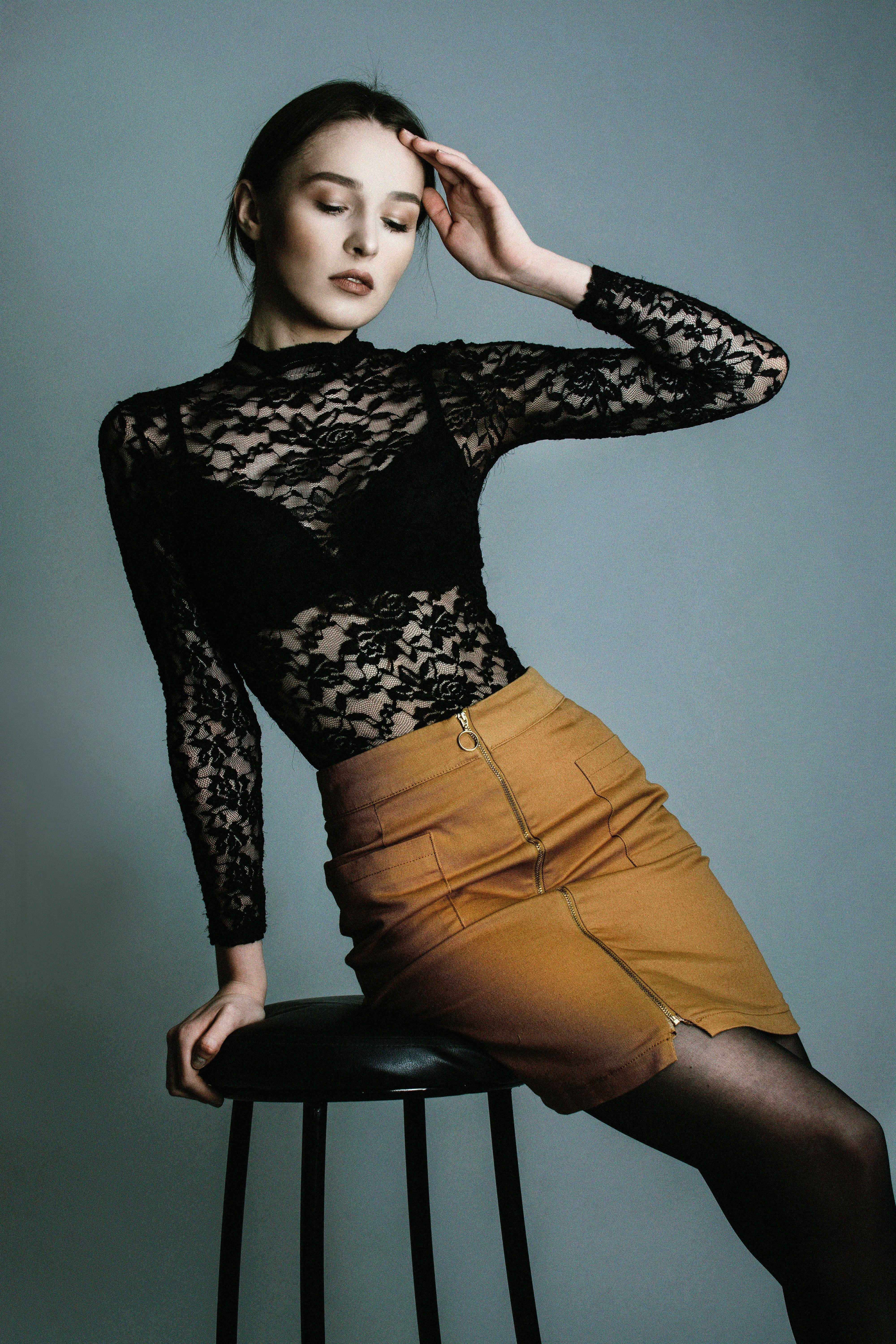
The Pencil Skirt- A Pivotal Point in Fashion History
The pencil skirt entered mainstream fashion by the early 1940's. Adapted and modified by many designers, Christian Dior is often credited as the inventor of the pencil skirt. However, the pencil skirt silhouette was already in the marketplace here in the United States before the launch of Christian Dior’s “H-Line” in Paris that has been recognized for introducing it. Christian Dior did give the pencil skirt a little something extra that propelled it forward into fashion stardom. An item that was utilitarian in nature was brought up to high fashion and spotlighted for its flattering effects.
Christian Dior’s, “New Look” debuted in 1947, showcasing a fuller silhouette. The 1954 Autumn/Winter Collection presented by Dior went in the opposite direction of the voluminous silhouettes of his “New Look”. Dior’s “H-Line” used the pencil skirt to emphasize a straight and narrow silhouette. It was less constraining than the 1940’s version of the pencil skirt. Christian Dior was an innovator of the pencil skirt rather than the inventor of it.


Top photo: Christian Dior's 1954 Paris fashion show.[photograph from Dior by Dior: The Autobiography of Christian Dior, photo copyright Association Willy Maywald ADAGP Paris and DACS London 2007,shown for historical commentary].
Bottom photo: The Henderson twins,photo by A.J. O'Brien, May 27, 1939 copyright[Rights holder if known](Flashback)Shown for historical commentary.
Necessity, the Mother of Invention
In the case of the pencil skirt, necessity was the mother of invention. Utilitarian in its concept, the pencil skirt became a staple in women’s wardrobes during the early 1940’s when they were entering the workforce in numbers replacing men who were at war. Garments with excessive material were not practical for this lifestyle. Materials rationing during the WWII era (Limitation Order L-85 in the United States), brought the pencil skirt to the fashion forefront for it’s simple, practical, and minimal fabric qualities.
Soon after the United States entered WWII in January of 1942, President Franklin D. Roosevelt established the War Production Board which among other things was tasked with converting civilian industries into industries to support and supply the war effort. Wool and nylon were some of the materials deemed necessary for the military and came under the General Limitation Order L-85. This order placed limitations on the amount of fabric permitted for use in garments and even listed measurements for women’s apparel items. The amount of fabric that could be used in the sweep or circumference of garments was limited to 72 inches for lighter weight wool and 64 inches for heavier weight wool and graded by size.
Skirts of the 1930s had been of various more feminine styles than the 1920’s, one of which closely evolved into the pencil skirt. The dirndl and pleated skirts were full silhouettes. A-line skirts were also popular in the 1930’s for their feminine appeal. The bias-cut skirts however, often paired with tailored jackets were fitted at the waist and hips and then fluted out at the bottom. This flattering and feminine style was also cut on the straight grain and widely worn as a separate piece in different fabrications. The restriction of bias-cut garments during the implementation of L-85 because of their extra fabric consumption and the modification of reducing the sweeps of skirts likely brought about the birth of the pencil skirt in the 1940s.
The shift in silhouette from the 1930's fit and flared skirt to the early 1940's tapered pencil skirt can be seen as a natural progression influenced by several factors.


The American fashion designer, Adele Simpson (1903-1995), was an intrinsic contributor of the war-time silhouette at a time when most leading designers were men. She was noted for simplifying women’s apparel and adding comfort to sophistication. She utilized the pencil skirt in her war-time designs.


Source: Vogue archive September 1943,
cover image. Copyright Conde Nast
(used under historical/educational context)
The Appeal of the Pencil Skirt
The icon status of the pencil skirt can be attributed to several factors. For one, it is a flattering style on most body types. It accentuates the waist and the curve of the hips as it tapers to the knee or below, creating an hour-glass shape and a slender appearance. The style evokes a sense of feminine elegance and refinement. The pencil skirt is highly versatile. The vital component of the power suit and the counter point to oversized sweaters and blouses, the pencil skirt is not only the uniform of the working woman, but a staple of everyday casual wear. The pencil skirt became a symbol of modern femininity. Television and Hollywood solidified its place in fashion annals glamourizing it and keeping it in fashion focus.

The 1940’s film-noirs dressed their femme fatales in pencil skirts. Celebrities such as Audrey Hepburn, Marilyn Monroe, Elizabeth Taylor, Lauren Bacall and Grace Kelly popularized pencil skirts on the screen. Nolan Miller, the highly esteemed costume designer of the 1980’s hit television show “Dynasty",depicting the luxurious lifestyle of oil tycoons, was influential in bringing the trend of large, square padded shoulders to women's suits paired with pencil skirts. Costume designer, Janie Bryant, chose the pencil skirt as a core wardrobe piece for the character, Joan Holloway, in "Mad Men", which ran from 2007-2015 and was set in the 1960's. Janie Bryant said of the style, "There is a level of empowerment in wearing that garment and a woman feeling feminine and strong.".
The skirt, like its namesake, became shorter over time. When Mary Quant, the British designer, introduced her pencil skirt raising the hemline several inches above the knee in the 1960’s it shook-up the fashion world. It was controversial and met with moral outrage from parts of the public and press. Mary Quant did not invent the mini skirt, but she brought it to new shorter lengths and used modern and innovative materials. She revolutionized how young women dressed with the intention of emphasizing freedom of movement and freedom from dressing like their mothers. No longer resembling a pencil, the mini and micro skirts are in their own class today.


Miu Miu SS '21 / April 1966, photo by Jack Garofalo [photos used for commentary purposes only]
Standing the test of time, the pencil skirt remains as relevant today as it was when it first entered the fashion scene in the 1940’s.
An array of pencil skirts over the last 25 years in fashion…


* Photos from various fashion shows/sources from 2000-2025 used for historical/analytical purposes.